01
You confuse variety with disorder.
Different fields can still share one center. The center is usually invisible until you force the pattern onto paper.
The ORBIT Map turns scattered interests into a visible operating system. It shows what sits at the center, what is drifting, and what deserves your next serious bet.
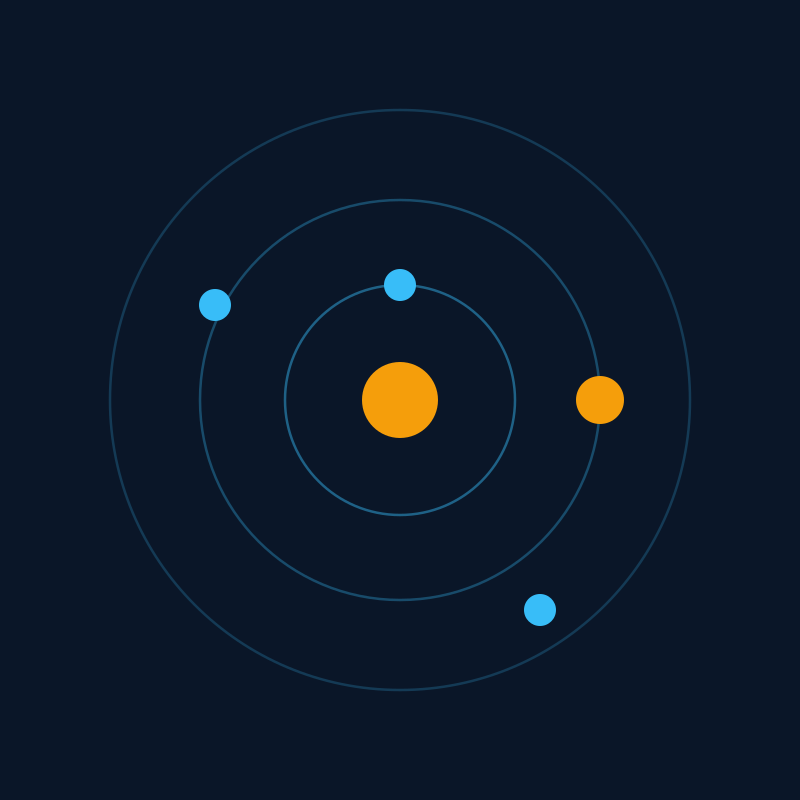
Without a map, every interest competes for attention. You keep asking what to focus on, but the better question is which interest explains the others.
Different fields can still share one center. The center is usually invisible until you force the pattern onto paper.
The thing getting attention this month may not be the thing with the deepest compounding value.
Some interests are rising. Some are useful bridges. Some are already dead and still consuming your calendar.
Instead of treating interests as a random list, ORBIT classifies them by function. That turns self-analysis into a working decision tool.
The hidden center. The drive that shows up across your interests, even when the surfaces look unrelated.
How far apart your interests sit in the real world, measured by tools, vocabulary, and customers.
The single interest that connects the others. Usually undervalued. Often the highest leverage thing you do.
The interest you could not stop even if you tried. Stated preferences lie. Inertia tells the truth.
The direction each interest is moving. Rising, plateaued, or fading. Most people refuse to mark anything fading.
A guided exercise that helps you identify the center of your interests, separate real momentum from distraction, and choose the next interest worth compounding.